
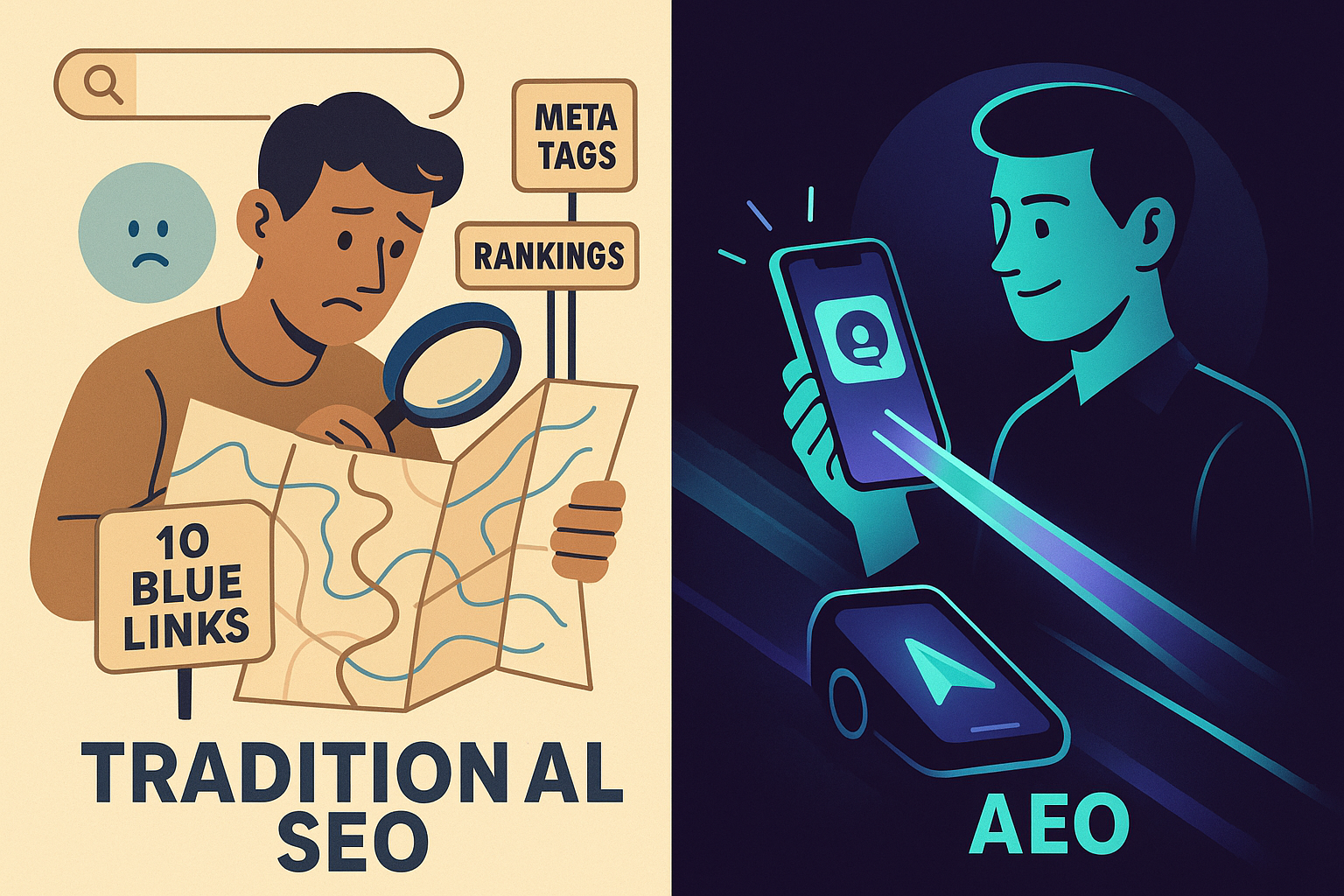
In the fast-paced world of digital marketing, staying ahead means constantly adapting. Just a few years ago, Search Engine Optimization (SEO) was primarily about sprinkling keywords, building backlinks, and tweaking meta tags to appease search engine algorithms. And for a long time, it worked. But the digital landscape is evolving at breakneck speed, driven by advancements in artificial intelligence and shifts in user behaviour.
Enter Answer Engine Optimization (AEO) – a powerful, future-forward approach that’s rapidly gaining prominence. If traditional SEO was about finding information, AEO is about getting direct answers. This isn’t just a minor tweak; it’s a fundamental shift in how we approach online visibility. So, why is comparing AEO vs SEO so important right now? Because understanding this evolution isn’t just about adapting; it’s about thriving.
This article will take you on a journey through the changing world of search. We’ll explore the foundational principles of traditional SEO, introduce you to the exciting realm of AEO, highlight their key differences, and most importantly, show you why AEO is becoming indispensable for your online success, especially as we head into 2025 and beyond. By the end, you’ll have a clear roadmap to navigate the future of SEO and leverage modern SEO strategies for maximum impact.
What is Traditional SEO?
Let’s start with the basics. Traditional SEO is the practice of optimizing your website and its content to rank higher in search engine results pages (SERPs) for specific keywords. Its core principles revolve around making your website attractive to search engine algorithms. Think of it as creating a well-organised library that search engines can easily catalogue and understand.
Common tactics in traditional SEO are likely familiar to many of you. They include meticulous keyword research to find terms people are searching for, building high-quality backlinks from other reputable websites to signal authority, crafting compelling meta tags (like titles and descriptions) that encourage clicks, and engaging in on-page SEO – optimising elements directly on your web pages such as headings, images, and content structure.
The strengths of traditional SEO lie in its foundational role. It helps search engines understand what your website is about, establish your credibility, and drive organic traffic by matching user queries with relevant content. However, it also has its limitations. Traditional SEO often focuses on transactional intent – users looking to buy something or visit a specific page – and primarily aims for organic listings. It’s built on traditional ranking signals and can sometimes fall short in addressing the nuances of natural, conversational queries that are becoming increasingly common. While it’s still crucial, it’s just one piece of the puzzle in the evolving landscape of search engine optimization best practices.
What is Answer Engine Optimization (AEO)?
Now, let’s dive into the exciting world of Answer Engine Optimization (AEO). So, what is Answer Engine Optimization? Unlike traditional SEO, which often aims to direct users to a webpage, AEO is all about directly answering user queries, often without the user ever having to click through to a website. It’s about satisfying the user’s need for immediate, concise, and accurate information.

This shift is largely driven by the pervasive influence of AI in SEO, the rise of voice search optimization, and the growing adoption of conversational search interfaces. When you ask Alexa, Siri, or Google Assistant a question, you’re interacting with an answer engine, not just a search engine. These systems use advanced AI to understand the intent behind your question and provide the most relevant, direct answer, often sourced from web content.
Examples of AEO in action are all around us. Think about featured snippets (those prominent boxes at the top of Google search results that provide a direct answer), knowledge panels, or the results you get when you ask a voice assistant a question like “What’s the weather like today?” or “How do I tie a Windsor knot?”. These are prime examples of how answer engine vs search engine experiences are fundamentally different. AEO optimises your content to be the source for these direct answers, making it highly visible in this new era of search. Optimising for SEO for voice assistants and featured snippets optimization are key components of a robust AEO strategy.
Key Differences Between AEO and Traditional SEO
Understanding the distinction between these two powerful approaches is crucial for anyone looking to master their online presence. While traditional SEO and AEO both aim for visibility, their core methodologies and desired outcomes diverge significantly. Let’s break down the difference between AEO and SEO:
One of the most profound distinctions lies in user intent focus: transactional vs. conversational. Traditional SEO often targets keywords with commercial or transactional intent – someone searching for “buy running shoes online” or “best CRM software.” The goal is to drive them to a product page or a service inquiry form. AEO, conversely, zeroes in on conversational or informational intent – someone asking “How do I clean running shoes?” or “What is CRM software?” The goal here is to provide a direct, satisfying answer.
This difference in intent naturally leads to content format differences: keyword-rich vs. answer-focused. Traditional SEO content is typically designed to be comprehensive and keyword-rich, aiming to cover a topic broadly to capture a range of related search queries. AEO content, however, is laser-focused on directly answering specific user questions clearly and concisely. It’s structured for immediate comprehension, often using lists, short paragraphs, or definitions.
The impact on search result placement: organic listings vs. featured snippets & answer boxes is also stark. With traditional SEO, success is often measured by ranking high in the organic blue links on a search results page. With AEO, the prime real estate is the “position zero” – the featured snippet, the answer box, or the direct audio response from a voice assistant. These placements offer unparalleled visibility and authority.
Finally, the technology impact: traditional ranking signals vs. AI-powered interpretation highlights the underlying shift. Traditional SEO relies on established signals like backlinks, keyword density, and site speed. AEO, on the other hand, leverages advanced AI and natural language processing (NLP) to understand the meaning and context of queries, not just the keywords. This means search engines are getting smarter at interpreting language and providing human-like answers, making AEO vs SEO a comparison of old-school tactics against cutting-edge AI.
| Feature | Traditional SEO | Answer Engine Optimization (AEO) |
| User Intent Focus | Primarily transactional queries | Primarily conversational queries |
| Content Format | Keyword-rich | Answer-focused content |
| Search Result Placement | Organic listings | Featured snippets & answer boxes |
| Technology Impact | Relies on traditional ranking signals | Driven by AI-powered interpretation |
Traditional SEO focuses on targeting search engine algorithms and common tactics include keyword research, backlinks, meta tags, and on-page SEO. In contrast, AEO focuses on directly answering user queries, leveraging AI, voice search, and conversational search, with examples seen in featured snippets and voice assistant results. While different, AEO is also described as complementing and enhancing traditional SEO efforts.
Why AEO Matters More Than Ever in 2025
The digital world is dynamic, and as we approach 2025, the reasons for embracing AEO are becoming increasingly undeniable. This isn’t just a passing trend; it’s the future of SEO.
Firstly, the rise of voice search and smart assistants like Alexa, Siri, and Google Assistant has been explosive. More and more users are opting for the convenience of speaking their queries rather than typing. When someone asks a voice assistant a question, they expect a single, direct answer, not a list of ten blue links. If your content isn’t optimised for this, you’re missing out on a massive, growing audience.
Secondly, the increased use of AI in search engines is fundamentally reshaping how search works. Google’s own updates, like BERT and MUM, demonstrate a move towards understanding language more contextually and conversationally. This means search engines are getting better at grasping user intent and providing precise answers, making AI in SEO a critical factor for success.
Thirdly, there’s the growing importance of quick, concise answers for mobile users. On smaller screens, users have less patience for sifting through long articles. They want immediate solutions. AEO caters perfectly to this need, delivering information efficiently. This also aligns with how user behavior is shifting towards conversational queries in general, as people become accustomed to the instant gratification offered by AI-powered assistants.
Finally, platforms like SeoByte are making it easier for businesses to adapt to this shift. SeoByte’s AI-powered tools are specifically designed to help businesses navigate the complexities of AEO. For instance, their Keyword Research Agent provides deep keyword research organised into tightly-knit keyword clusters, enriched with intent. Their Content Writing Agent crafts impactful, SERP-friendly content, complete with FAQs and internal links, aligning with your AEO strategy. Furthermore, the Traffic Analytics Agent monitors your performance, flagging areas for high-impact content improvements, ensuring your modern SEO strategies are always yielding results and contributing to the impact of AEO on website traffic. By embracing AEO importance 2025, you’re positioning your brand for sustained visibility and growth.
How to Optimize Your SEO Strategy for AEO
Now that you understand why AEO is so vital, let’s talk about the actionable steps you can take to adapt your SEO strategy for this new era of search.
The first crucial step is to focus on question-based keywords and long-tail queries. Instead of just targeting “organic coffee,” think about “how to brew organic coffee at home” or “what are the benefits of fair trade organic coffee?” These are the types of natural language questions users ask voice assistants and type into search engines when seeking direct answers. Tools like SeoByte’s Keyword Research Agent can help identify these specific, intent-driven queries and organise them into relevant clusters, ensuring your content directly addresses user needs.

Next, it’s essential to be creating content that answers specific user questions clearly. Your content should be designed to provide a direct, concise answer upfront, followed by more detailed information. Imagine you’re writing a helpful response to a friend’s question. This means prioritizing clarity and avoiding jargon. SeoByte’s Content Topics Recommendation Agent can help you discover thousands of content ideas centered around your brand, recommending topic clusters and subtopics based on keyword themes and ranking potential, ensuring your content is always relevant and answer-focused.
To maximise your chances of securing those coveted “position zero” spots, you need to be structuring content for featured snippets and rich answers. This often involves using clear headings (H1, H2, H3), bulleted or numbered lists, tables, and definitions. Make sure your answers are easily extractable by search engines. Also, consider leveraging schema markup and FAQ sections. Schema markup helps search engines understand the context of your content, while well-structured FAQ sections are prime candidates for featured snippets and voice search answers. SeoByte’s Content Writing Agent, for example, automatically enriches every piece with SERP-friendly elements like FAQs and internal links, streamlining this process for you.
Finally, don’t shy away from using SeoByte’s AI tools for keyword research and content optimization for AEO. These tools are designed to streamline complex SEO processes. Their Competitor Research Agent continuously scans competitor sites to identify content formats and high-performing assets, helping you discover untapped opportunities. The Content Quality Check Agent assesses your content for SEO elements, relevance, and originality, even predicting how well it will rank with AI-powered performance insights. This means you’re not just guessing; you’re making data-driven decisions for your AEO content strategies and overall SEO tools for AEO. Remember, you don’t need technical knowledge to use SeoByte’s AI Agent; it translates complex concepts into simple, actionable steps.
The Role of Traditional SEO in an AEO World
Given all the buzz around AEO, you might be wondering if traditional SEO is now obsolete. The answer is a resounding “No!” Traditional SEO is still relevant and remains the bedrock of a strong online presence. Think of it this way: AEO is about getting featured snippets and direct answers, but those answers still need to come from a credible, well-optimised website.
Traditional SEO techniques, such as robust technical SEO (site speed, mobile-friendliness, crawlability), building a strong backlink profile, and ensuring overall site authority, are all crucial underlying factors that influence whether your content is even considered by an answer engine. A search engine or answer engine is more likely to pull a direct answer from a website it trusts and considers authoritative.
Therefore, AEO complements and enhances traditional SEO efforts. It doesn’t replace it. Traditional SEO builds the strong foundation – the house, if you will – and AEO ensures that your most valuable information (the answers) are prominently displayed on the front porch for everyone to see. By integrating both strategies for maximum search visibility, you create a powerful synergy. You build a comprehensive and authoritative website through traditional search engine optimization best practices, and then you fine-tune specific content to cater to the immediate, conversational needs of users through AEO. This holistic approach ensures you capture traffic from both traditional search queries and the rapidly growing segment of answer-driven searches, leading to truly effective modern SEO strategies.
Case Study: SeoByte’s Impact on a D2C Smart Water Purifier Brand
To truly illustrate the power of combining these strategies, let’s look at a real-world example from SeoByte’s portfolio.
A D2C Smart Water Purifier Brand was struggling with its online presence. Despite having a quality product, their website’s visibility was low, and their search engine rankings were stagnant. They were missing out on valuable organic traffic and leads, indicating a significant keyword gap and limited reach in the evolving search landscape. They needed to boost their impact of SEO on website traffic.
SeoByte partnered with the brand, implementing an Outcome Driven SEO strategy led by experts and powered by their AI Agents. They didn’t just focus on traditional keyword rankings; they embraced the shift towards AEO. Using SeoByte’s Keyword Research Agent, they identified long-tail, question-based queries related to water purification, such as “how smart water purifiers work,” “benefits of filtered water for health,” and “best water purifiers for hard water”. The Competitor Research Agent helped them understand what their rivals were doing well in terms of content formats and conversational queries, revealing untapped opportunities.
The Content Writing Agent was then deployed to craft new, answer-focused content, specifically designed to address these user questions directly and concisely, ideal for featured snippets and voice search responses. Existing content was also optimised for SEO, ensuring clarity and schema markup integration.
The results were transformative. According to the brand’s founder, “SeoByte has been a game-changer for our online presence. Their strategies boosted our website’s visibility, improved search engine rankings, and led to a significant increase in inquiries and sales. Thanks to their expertise, Our Brand’s online presence and business growth have never been stronger”. The improvements weren’t just in traditional organic rankings; they saw a noticeable increase in direct answers and featured snippet appearances for relevant queries. The Traffic Analytics Agent helped monitor domain and page-level performance, tracking the expected versus actual outcomes, ensuring the strategy remained aligned with their business goals. This case exemplifies how a comprehensive strategy, embracing both traditional SEO foundations and cutting-edge AEO principles, can lead to substantial improvements in traffic, rankings, and engagement, driving real business growth.
Conclusion
The journey of SEO is one of continuous evolution. From its keyword-centric origins to the sophisticated, intent-driven world of Answer Engine Optimization, the goal remains the same: to connect users with the most relevant, valuable information. Understanding the difference between AEO and SEO isn’t about choosing one over the other; it’s about integrating both for a holistic and incredibly powerful online presence.
As AI in SEO continues to advance and user behavior shifts towards conversational queries and voice search, embracing AEO alongside traditional SEO is no longer optional – it’s essential for relevance and growth. This comprehensive approach ensures that your brand is not only discoverable but also provides immediate, satisfying answers that build trust and authority.
Don’t let your business fall behind in the rapidly changing digital landscape. The future of SEO is here, and it’s conversational. Are you ready to adapt your SEO strategies with these emerging trends? Try SeoByte’s tools to optimize for both SEO and AEO. Their AI-powered solutions, combined with human expertise, can help you define your targets, create a winning strategy, and achieve your goals, ensuring your business thrives in this new era of search. Book your free consultation today and redefine your online presence.
FAQs
1. What is the difference between Answer Engine Optimization (AEO) and traditional SEO?
Answer Engine Optimization (AEO) focuses on providing direct, concise answers to user queries, often without requiring a website visit. In contrast, traditional SEO aims to improve rankings in search engine results pages (SERPs) through techniques such as keyword optimization, backlinks, and meta tags.
2. Why is Answer Engine Optimization important in 2025?
As voice search and AI assistants become more prevalent, AEO is essential for ensuring that your content is discoverable and accessible in a format that aligns with modern user behavior. It enables businesses to appear in featured snippets and voice assistant responses, improving visibility and engagement.
3. How does AEO work with voice assistants like Siri or Alexa?
AEO structures content in a way that voice assistants can easily interpret and deliver. By using schema markup, FAQs, and conversational phrasing, content becomes optimized for direct answers, allowing assistants like Siri, Alexa, or Google Assistant to respond accurately and efficiently.
4. Does AEO replace traditional SEO?
No, AEO does not replace traditional SEO. Instead, it complements it. Traditional SEO provides the foundational elements such as website authority, technical optimization, and backlinking, while AEO focuses on optimizing specific content to answer user questions directly.
5. What are real-world examples of AEO in action?
Examples of AEO include featured snippets on Google, voice search responses from smart assistants, and knowledge panels. When users receive an instant answer to queries like “What is CRM software?” or “How to make cold brew coffee?” without clicking through, AEO is at work.
Don’t let your content get left behind.
As search behavior evolves, so should your strategy. Discover how SeoByte helps brands win across both SEO and AEO—powered by AI, refined by experts.
Talk to us today and unlock your growth.
Leave a Reply